
On this page
If you are dreaming of sailing the Greek islands with a crew to do the work, the first question is the money. A crewed catamaran charter in Greece costs from about €15,000 a week for a 46 ft catamaran in high season to €60,000 and more for a 60 ft luxury boat. That is the charter fee. On top come the APA, Greek VAT and a tip for the crew, which together add roughly half again.
Below is what a week costs, every line priced the way you would pay it, and what moves the number up or down. The figures are typical 2026 and 2027 rates from Lefkada, where we are based, and they hold for most of Greece.
Yacht charter prices in Greece for crewed catamarans, by size
The size of the boat drives the price more than anything else. Bigger catamarans carry more crew, and the crew is a large part of what you pay for.
| Size | Typical yachts | Guests | Crew | High-season week |
|---|---|---|---|---|
| Family catamarans | 46–48 ft | up to 8 | 2 | €15,000–20,000 |
| Large catamarans | 50–55 ft | 8–10 | 2–3 | €20,000–36,000 |
| Luxury catamarans | 60 ft and up | 8–10 | 4–5 | €35,000–60,000+ |
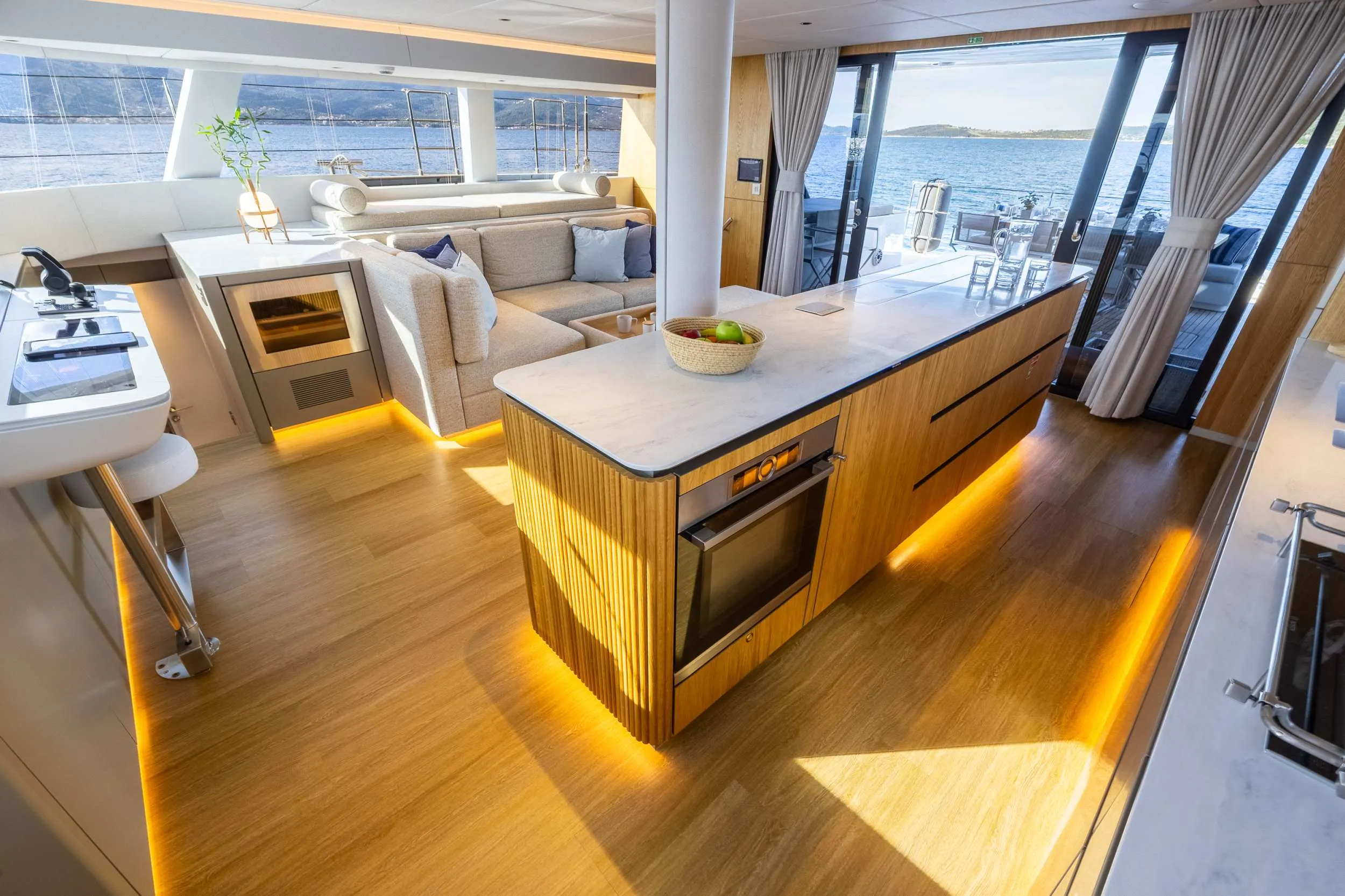
A typical family boat is a four-cabin catamaran from Lagoon, Bali or Fountaine Pajot, run by a captain plus a chef or host. At the crewed luxury end you find yachts such as the Sunreef 60: a flybridge, four crew or more and a more polished service. A power catamaran or motor yacht costs more again, mostly because it burns far more fuel. Catamaran fuel use under sail is modest by comparison.
These figures are the base charter fee, before the costs below. The final number depends on the boat, the week and how the charter company prices its crew.
What the charter fee covers
The weekly rate is the price of the boat itself. On most crewed catamarans in Greece it includes:
- The crew and their wages. On some boats the crew is a fixed extra, typically €3,500–5,500 a week. Check which way a quote is built.
- The crew’s food, cabins made up daily, linen, towels and final cleaning.
- Water toys: usually a tender, paddleboards and snorkeling gear.
- Insurance of the boat and its equipment. Travel and cancellation insurance for your group is not included.
What it does not cover is the cost of running the week. That is what the APA is for.
The APA: where the rest of the money goes
APA stands for advance provisioning allowance. You pay it before the trip, on top of the rate, and the captain spends it on your behalf:
- Provisioning: the food the chef cooks, shopped to your preference sheet.
- Drinks, from water to wine.
- Fuel for the boat and the tender.
- Port fees and marina dues.
On a sailing catamaran the APA is usually around 30% of the rate. Motor yachts ask for more, because of fuel.
The APA is still your money. The captain keeps every receipt, you get an itemized account and the receipts at the end, and any balance comes back to you. If you spend more, you top it up during the week.
Greek VAT on a yacht charter
VAT in Greece varies with the boat. It is charged on the rate, not on the APA. The full figure is 24%, but most crewed quotes charge VAT at the rate of about 12%, a reduction that depends on the boat’s license and where it sails. The contract states the exact figure, so you know it before you pay.
Crew gratuity: how much to tip
The custom in Greece is a tip of 10–15% of the weekly rate, handed to the captain at the end of the trip. It is not part of the contract and it is entirely your call. Most guests tip toward the top of that range when the week has gone well.
How much does it cost? A real catamaran week from Lefkada
Here is a July week on a large catamaran: a 51 ft boat with four guest cabins, a captain and a chef, eight guests, seven nights from Lefkas Marina.
| Line | Amount |
|---|---|
| Charter fee, crew included | €20,000 |
| Greek VAT at about 12% | €2,400 |
| APA at 30% | €6,000 |
| Paid before the trip | €28,400 |
| Tip for the crew at 10% | €2,000 |
| All-in for the week | €30,400 |
That is about €3,800 per person for the week, or around €540 per person a night, with every meal cooked on board and a captain who plans each day around the weather.
How the APA typically goes on a week like this: a little over half on food and drinks, around a third on fuel, and the rest on port fees. Among the inner islands the legs are short, so fuel use is modest and some of the APA often comes back.
What it costs per person
The rate stays the same whether six or ten of you come, so the per-person price falls fast as the group grows. On the same example week, all-in:
| Guests | Per person, per week | Per person, per night |
|---|---|---|
| 6 | about €5,070 | about €725 |
| 8 | about €3,800 | about €540 |
| 10 | about €3,040 | about €435 |
Ten is the comfortable maximum on most boats, and twelve is the legal limit for any charter yacht.
What makes the price go up or down
The week
July and August are the most expensive weeks. June and September usually cost 20–40% less for the same boat, with warm water and quieter anchorages. October is cheaper again. In the shoulder weeks you can often move up a size for the same budget.
The size of the yacht
Every step up in length adds cabin space, deck space and usually crew. If your group fits a family catamaran, you pay for the boat you use rather than space you don’t.
Where you sail
Greece offers two very different cruising areas, and the running costs change with each. More on that below.
How many guests
The price of the boat is the same for six guests or ten. More guests means a lower price per person, though provisioning rises with every mouth.
Ionian or Cyclades: which costs less?
Most crewed charters start from Athens and head for the Cyclades, sailing the Aegean Sea to Mykonos, Santorini and Paros. The other main area is the Ionian Sea on the west coast, with bases in Lefkada and Corfu. A boat of the same size costs much the same in both. What differs is the week around it.
In the Aegean, the islands are farther apart and the summer meltemi wind can blow hard for days. Longer passages mean more fuel, and the famous harbors, Mykonos above all, are among the most expensive in Greece.
On the west coast, Lefkada, Meganisi, Kalamos, Ithaca and Kefalonia sit an hour or two apart in sheltered water: smooth sailing for most of the summer. You motor less, anchor more and spend more of the APA on food than on fuel. The trade-off is getting there: from the US you fly to Athens, then take a one-hour domestic flight to Preveza, or connect through a European hub.
For a first sailing vacation, or a group with children, the Ionian is usually the easier week and the better buy. If the plan is nightlife in Mykonos, budget for it. Our 7-day itinerary from Lefkada shows what a typical Greek island week looks like.
Hidden costs to budget for
Most of the costs associated with a charter that surprise people are not hidden, just left out of the headline price:
- Airport transfers to and from the marina. For Lefkada, the nearest airport is Preveza (PVK), about 30 minutes away.
- A delivery fee if you want to start or finish somewhere other than the boat’s base.
- Premium drinks. A few cases of good wine or champagne move the APA quickly.
- Shore excursions, dinners ashore and anything you book on land.
- Travel insurance for your group, which we strongly recommend.
None of these are large next to the price of the boat, but together they deserve a line in your budget.
Is a catamaran with crew worth the money?
Set the per-person figure against what it replaces. On the example week, about €540 per person a night covers a private cabin with its own bathroom, every breakfast and lunch cooked on board, a fully crewed yacht, the fuel to reach a new Greek island each day and a different swimming bay every morning.
Pricing the same week on land means a villa, a driver, ferries between islands and most meals out. For a group of eight, that adds up quickly, you pack and unpack every time you move, and the itinerary follows a ferry timetable instead of the weather.
What you cannot buy on land is the anchorage: lunch at a table on deck in a bay you reached by sea, with nobody else there.
When to book, and when to set sail
July and August weeks on the best crewed boats often sell six to twelve months ahead. If your dates are fixed to school vacations, start looking the fall before.
June and September are the sweet spot: warm sea, settled weather and prices 20–40% below peak. October is quieter and cheaper again, with shorter days. Our guide to the best time to sail in Greece goes month by month.
How booking and payment work
Every Greek crewed charter is booked under a standard MYBA contract with the company that operates the boat. Usually you pay half on signing and the balance, plus the APA, about a month before the trip.
You do not pay more for using a charter broker. The broker’s commission comes out of the price the owner sets, so a good broker costs you nothing and does the comparing for you.
Cheaper ways of chartering a yacht in Greece
If the budget is tighter, there are two ways to bring down the cost to charter a yacht in the same islands:
- A skippered yacht charter. A captain only, on a sailing yacht or catamaran, and you look after meals yourselves. See skippered or bareboat for how that week works.
- A bareboat charter. You sail it yourself and need a recognized license.
A crewed yacht charter costs more because the crew does everything else: the cooking, the cleaning, the planning. The cost of a crewed catamaran buys the one thing the others don’t, a week with nothing to organize. Our post on all-inclusive yacht charters in Greece compares the options side by side.
Crewed catamaran charter Greece cost: the short version
- Charter fee: €15,000–20,000 for a family catamaran, €20,000–36,000 for a large one, €35,000 and up for a luxury yacht in high season.
- Add about 30% for the APA, which is accounted for and any balance returned.
- Add VAT, usually around 12%.
- Plan on 10–15% for the crew gratuity.
- Save 20–40% by sailing in June or September.
If you would like real figures for a week in Greece with your group, tell us how many you are and roughly what you want to spend. We will shortlist the crewed catamarans from Lefkada that fit, with the full weekly cost of each, within a day.
Frequently Asked Questions
-
How much does it cost to charter a crewed catamaran in Greece for a week?
In high season, from about €15,000 for a 46–48 ft catamaran to €35,000–60,000 or more for a 60 ft luxury boat. Add roughly 30% for the APA, Greek VAT (usually around 12%) and a tip of 10–15%. June, September and October cost noticeably less than July and August.
-
What is included in a crewed charter?
The weekly rate covers the boat, its crew on most boats, insurance of the boat, linen, towels, cleaning and the water toys. Food, drinks, fuel and port fees come out of the APA, which you pay in advance and the captain accounts for.
-
What is the APA on a yacht charter?
The advance provisioning allowance: money you pay before the trip, usually around 30% of the rate on a sailing catamaran, which the captain spends on your food, drinks, fuel and port fees. You get an itemized account and any balance back.
-
How much do you tip the crew in Greece?
The custom is 10–15% of the weekly rate, paid to the captain on the last day and shared among the crew. It is discretionary and reflects the service you received.
-
What is the 12-person rule on a yacht?
A charter yacht can carry at most 12 guests; above that it counts as a passenger ship under international rules. Most catamarans take 8 to 10 guests. Larger groups book two boats and sail together.
-
Do I need a sailing license to charter a catamaran with crew?
No. The captain holds the license and is responsible for the boat. Nobody in your group needs sailing experience.
-
When is the cheapest time to charter a catamaran in Greece?
June and September give the best value, with warm water and settled weather. October is cheaper still. July and August are the most expensive weeks and book out first.
-
How far in advance should I book a catamaran with crew in Greece?
For July and August, six to twelve months ahead; the best boats in each size go first. Shoulder-season weeks can often be booked two to four months out.