




Do you need a license to charter a yacht in Greece? It’s an exciting plan—but it can get confusing fast once you start reading about licenses, certificates, and Greek port authorities. The good news: most travelers don’t need to “figure out Greek law” on their own. You just need to choose the right type of charter and make sure the paperwork matches your plan.
Disclaimer: This is general guidance, not legal advice. License requirements can vary by charter company, yacht type (including catamaran), and local port authorities in Greek waters.
TL;DR
- If you book a skippered yacht charter, you typically don’t need a sailing license yourself because the yacht skipper is the qualified person in charge.
- If you book a bareboat charter (without a skipper), you’ll usually need a sailing license or a certificate that the charter company accepts (often International Certificate of Competence (ICC) or equivalent), plus sailing experience.
- Some operators may ask for one experienced crew member (at least one crew member besides the skipper who is competent).
- You may be asked for a VHF/SRC certificate and to send original copies or scans of documents before arrival.
- If you don’t have qualifications, you can still charter: choose skippered, or consider a bareboat cruising course / training week.
The quick answer: bareboat vs skippered charters in Greece
When people ask, “do you need a license to charter a yacht in Greece,” they’re usually comparing two options:
Skippered yacht charter (most flexible for travelers)
A skippered charter means a professional skipper is on board. In many cases, that means you can charter in Greece without holding a sailing licence yourself. You’re still part of the sailing (if you want), but the skipper handles responsibility, navigation, and decision-making—especially when conditions change or you’re mooring in varying conditions.
If you want a stress-free week from Lefkada, take a look at our skippered yacht charter options
Bareboat charter (you are the skipper)
A bareboat charter means without a skipper—you (or someone in your group) is the skipper. This is where license requirements matter. Charter companies typically ask for:
- Proof of competence (license/certificate)
- A short sailing CV showing previous experience
- Sometimes, a competent co-skipper / one experienced crew member
Yacht charter Greece license requirements (what companies look for)
For a bareboat yacht charter in Greece, the charterer is usually expected to show that there is at least one certified skipper on board. In practice, companies look for a mix of:
- A recognized qualification
- Real-world experience (routes, boat size, conditions)
Common certificates (examples)
Depending on your background, charter companies may accept:
- International Certificate of Competence (ICC) (often the simplest “international” proof)
- RYA Day Skipper license (or higher)
- National licenses from EU countries
- ASA 104 or US Sailing equivalents (often accepted, sometimes with extra prerequisites or a stronger sailing CV)
If you’re coming from outside Europe (non-EU), don’t stress—many visitors charter every season. Just expect the company to ask for clear documentation and experience details.
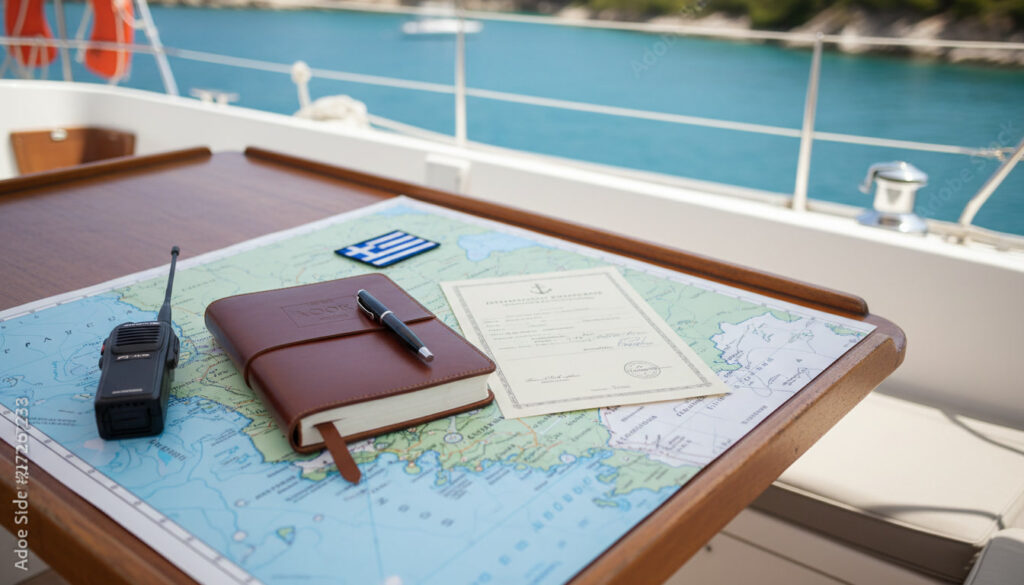
Practical tip: Your sailing certificates must be sent in advance (scans are usually fine) so the operator can confirm acceptance before the start of the charter.
Yacht charters in Greece: what changes depending on your plan
Greece is one of the world’s most popular sailing destinations—Ionian Islands, Cyclades, Dodecanese, and more. But the paperwork and checks can differ based on:
- Bareboat vs skippered
- Yacht type (monohull vs catamaran)
- Whether the yacht is a commercial yacht
- The operator’s compliance process (some are stricter than others)
That’s why two people can read two different blog posts and feel like they’re getting conflicting answers. Often, they’re talking about different charter types.
Greek Charter License: the basics (what people mean by “GCL”)
You’ll see terms like Greek charter licence or Greek charter license (GCL) online. In many cases, this is shorthand people use when discussing compliance and documentation for yachts operating in Greece.
As a guest, you usually don’t “apply for a Greek charter license” yourself. What matters to you is:
- Are you chartering a properly documented yacht?
- Are you chartering bareboat or with a skipper?
- Do you meet the operator’s prerequisites for bareboat?
If you’re booking with a reputable company, they handle the vessel-side compliance and tell you exactly what they need from you.
Benefits of a Greek Charter License (why it matters to guests)
From a guest perspective, the “benefit” is simple: smoother, safer sailing. Proper documentation helps ensure:
- The yacht can legally operate and cruise in Greek waters
- The charter process is straightforward at the Greek port
- You’re less likely to face last-minute surprises at check-in
In other words: it’s not about bureaucracy—it’s about avoiding stress.
In order to sail in Greek waters, you will need to have:
This section applies mainly to bareboat charters in Greek waters. Most operators will want:
- A recognized sailing license or a certificate (often ICC / RYA)
- A sailing CV showing sailing experience (boat size, conditions, role)
- Sometimes a VHF certificate (SRC)
- A plan for crew competence (at least one crew member who can assist)
- Copies of passports/travel documents (especially for non-EU travelers)
Some operators may also ask you to confirm you can:
- Use navigation and pilotage skills
- Know your position at any time
- Plan the day’s sailing (weather, distances, safe harbors)
- Anchor safely and handle mooring in varying conditions
That might sound intense, but it’s basically the real-world skill set of a responsible skipper.
A skipper in Greece is required to have one (1) of the following licenses
For bareboat, the skipper is expected to show competence. The exact accepted list varies, but commonly includes:
- ICC (International Certificate of Competence)
- RYA Day Skipper / Yachtmaster track
- National licenses accepted by the operator
If you’re unsure whether your certificate is accepted, ask the charter company early. It’s normal.
Do you need a boat license in Greece?
If you’re chartering with a skipper, you typically don’t need a boat license.
If you’re chartering bareboat, yes—you’ll likely need an accepted qualification (boat license / sailing license) plus experience.
Do you need an ICC certificate to sail in Greece?
For bareboat, ICC is one of the most commonly accepted options and often the easiest “international” proof of competence. Some charter companies accept alternatives, but ICC is frequently the cleanest answer.
What about an IPC, SLC, or other certificates?
You may see terms like IPC or SLC mentioned in competitor content. The key point isn’t the acronym—it’s whether the charter company accepts your certificate as proof you can safely skipper the yacht.
If you have a less common certificate, send it early with a short sailing CV and ask for confirmation.
Do you need one experienced crew member (competent co-skipper)?
Some operators ask for one experienced crew member in addition to the skipper—especially for larger yachts or if your experience is light.
Sometimes this is handled via a simple statement or legal declaration that said crew member is competent. In other cases, the operator may want to see a second certificate.
If your group doesn’t have that, you have easy alternatives:
- Add a skipper (turn it into a skippered charter)
- Choose a simpler route/area (Ionian Islands are often calmer than the Aegean)
- Consider a training week first
Greek port authorities: what happens at check-in?
Depending on the operator and location, there may be documentation checks linked to the Greek port authorities. That’s why you’ll hear phrases like:
- “Provide a legal declaration”
- “Fill out a declaration”
- “Declaration to the Greek port”
- “Sailing certificates must be sent”
Most of the time, this is routine. The operator guides you through it. Your job is simply to have your documents ready and accurate.
Can yachts without a GCL or e‑Permit cruise in Greece?
You’ll see this question online because travelers want to avoid issues while cruising. In practice, reputable operators ensure the yacht’s paperwork is in order (including any permits required for charters in Greek waters).
As a guest, the best move is simple:
- Charter through a reputable operator
- Confirm what’s included and what documents they require from you
If something feels unclear, ask before paying the charter fee.
What if you don’t have a license?
You still have great options in Greece:
1) Skippered yacht charter (easy, safe, relaxed)
This is the best fit for first-timers, families, and mixed-experience groups. You get the full yacht charter experience without worrying about prerequisites.
2) Learn-first: bareboat cruising course / Day Skipper course
If your goal is to bareboat in the future, a bareboat cruising course (or day skipper course) can help you build real skills: navigation, pilotage, anchoring, mooring, planning the day’s sailing, and confidence.
Final checklist before you book
- Confirm whether you’re booking bareboat or skippered
- If bareboat: confirm accepted license/certificate (ICC / RYA Day Skipper / equivalent)
- Prepare a short sailing CV: routes, conditions, role, boat size
- Confirm whether you need VHF/SRC
- Confirm crew plan (at least one crew member who can assist)
- Send documents early (and bring originals if requested)